How to Convert kJ to Calories: Formula, Examples & Table
Understanding how to convert kilojoules (kJ) to calories is important for reading nutrition labels, tracking energy intake, managing fitness goals, and comparing food energy values across countries. Many food products in Europe, Australia, New Zealand, and other regions display energy in kilojoules, while people in the United States commonly use calories or kilocalories (kcal).
Although the conversion itself is simple, many people still confuse calories, kilocalories, joules, and kilojoules. This guide explains the exact conversion formula, practical examples, nutrition labelling standards, and common mistakes people make when converting energy units.
Whether you are a student, diet-conscious consumer, athlete, nutrition writer, or health professional, this article will help you accurately convert kJ to calories using scientifically correct methods.
What Is kJ?
A kilojoule (kJ) is a metric unit of energy used in the International System of Units (SI). It measures how much energy food provides to the body. One kilojoule equals:
- 1,000 joules
- Approximately 0.239 calories
- Approximately 0.239 kilocalories in food labeling context
Countries that commonly use kilojoules on nutrition labels include:
- Australia
- New Zealand
- European Union countries
- South Africa
Food energy, exercise output, and metabolic activity are often measured in kilojoules because SI units are internationally standardised.
What Are Calories?
In nutrition science, the word “Calories” usually refers to kilocalories (kcal), not small calories (cal). There are two types of calories:
| Unit | Meaning | Value |
| cal | Small calorie | Energy needed to raise 1 gram of water by 1°C |
| kcal | Kilocalorie (food calorie) | 1,000 small calories |
On food labels:
- 1 Calorie (capital C) = 1 kilocalorie (kcal)
This is why a snack labelled as “250 Calories” actually contains:
- 250 kcal
- 250,000 small calories
Understanding this distinction is essential for accurate kJ to calorie conversion.
kJ to Calories Conversion Formula
The scientifically accepted conversion formula is:
Formula
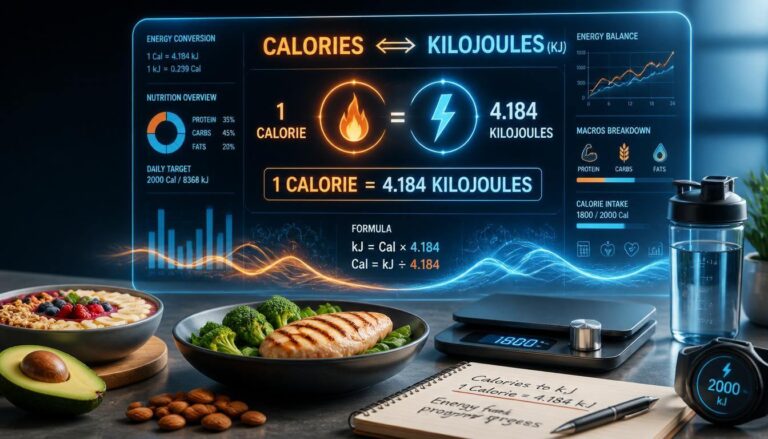
Calories (kcal) = Kilojoules (kJ) ÷ 4.184
This formula comes from the standard thermochemical relationship between joules and calories.
Another useful formula is:
1 kcal = 4.184 kJ
These formulas are recognised in nutrition science, chemistry, food technology, and international labelling regulations.
If you want faster calculations without manual division, try the kJ to Cal Converter for instant results.
How to Convert kJ to Calories Step by Step
Converting kilojoules to calories only requires basic division. Once you remember the conversion factor 4.184, calculations become very easy.
Step 1: Identify the kJ Value
Suppose a food label shows:
- Energy = 840 kJ
Step 2: Divide by 4.184
Use the formula:
Calories = 840 ÷ 4.184
Step 3: Get the Result
840 ÷ 4.184 = 200.76 kcal
Rounded value:
- Approximately 201 calories
This means the food contains around 201 Calories.
Quick kJ to Calories Conversion Table
The following table helps you instantly convert common kilojoule values into calories.
| Kilojoules (kJ) | Calories (kcal) | Kilojoules (kJ) | Calories (kcal) | Kilojoules (kJ) | Calories (kcal) |
| 9000 kJ | 2151.05 kcal | 8200 kJ | 1959.85 kcal | 7700 kJ | 1839.39 kcal |
| 3888 kJ | 929.06 kcal | 3750 kJ | 896.27 kcal | 3360 kJ | 803.06 kcal |
| 3180 kJ | 759.08 kcal | 3024 kJ | 722.75 kcal | 2850 kJ | 681.17 kcal |
| 2460 kJ | 587.95 kcal | 2000 kJ | 478.01 kcal | 1980 kJ | 473.23 kcal |
| 1970 kJ | 470.84 kcal | 1500 kJ | 358.51 kcal | 1310 kJ | 313.10 kcal |
| 1299 kJ | 310.47 kcal | 1000 kJ | 239.01 kcal | 968 kJ | 231.36 kcal |
| 952 kJ | 227.53 kcal | 702 kJ | 167.78 kcal | 659 kJ | 157.50 kcal |
| 621 kJ | 148.42 kcal | 478 kJ | 114.24 kcal | 432 kJ | 103.25 kcal |
| 396 kJ | 94.65 kcal | 395 kJ | 94.41 kcal | 393 kJ | 93.93 kcal |
| 386 kJ | 92.26 kcal | 384 kJ | 91.78 kcal | 373 kJ | 89.15 kcal |
| 366 kJ | 87.48 kcal | 363 kJ | 86.76 kcal | 324 kJ | 77.44 kcal |
| 320 kJ | 76.48 kcal | 312 kJ | 74.57 kcal | 309 kJ | 73.85 kcal |
| 215 kJ | 51.39 kcal | 213 kJ | 50.91 kcal | 188 kJ | 44.93 kcal |
| 186 kJ | 44.46 kcal | 162 kJ | 38.72 kcal | 146 kJ | 34.89 kcal |
| 10 kJ | 2.39 kcal | 5 kJ | 1.20 kcal | 2500 kJ | 597.5 kcal |
| 3000 kJ | 717 kcal | 5000 kJ | 1195 kcal | 10000 kJ | 2390 kcal |
This table is especially useful for nutrition planning, fitness tracking, and comparing packaged foods.
Why Food Labels Use kJ Instead of Calories
Many governments follow the International System of Units (SI), which officially recognizes joules as the standard unit of energy.
That is why nutrition labels in several countries display energy values in:
- Kilojoules (kJ)
- Kilocalories (kcal)
Some labels show both values together.
For example:
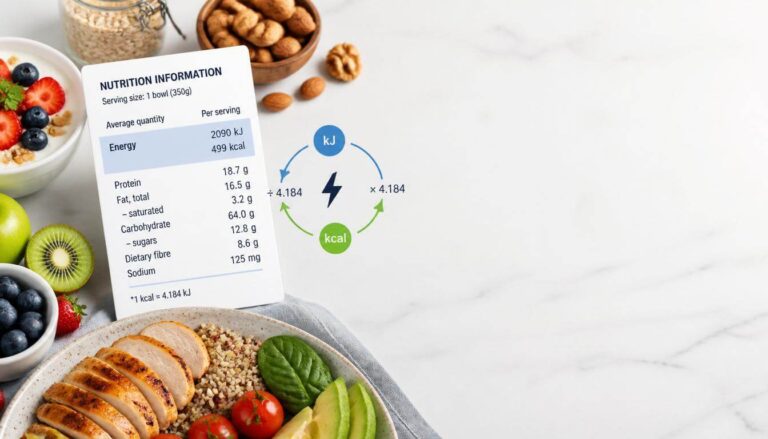
- Energy: 870 kJ / 208 kcal
This dual-labelling system helps international consumers understand nutritional information more easily.
Difference Between kJ and kcal
Although both units measure energy, they belong to different measurement systems.
| Feature | kJ | kcal |
| Full Form | Kilojoule | Kilocalorie |
| Measurement System | SI Metric System | Traditional Heat Unit |
| Common Usage | Europe, Australia | USA, fitness industry |
| Scientific Standard | Yes | Widely accepted in nutrition |
| Conversion | 1 kcal = 4.184 kJ | 1 kJ = 0.239 kcal |
The actual energy represented is the same. Only the unit changes.
Real-Life Examples of kJ to Calories Conversion
Understanding practical examples makes conversion much easier in daily life.
Example 1: Protein Bar
Nutrition label:
- 950 kJ
Calculation:
950 ÷ 4.184 = 227 kcal
Result:
- Protein bar contains approximately 227 calories.
Example 2: Soft Drink
Energy value:
- 620 kJ
Calculation:
620 ÷ 4.184 = 148.2 kcal
Result:
- Soft drink contains around 148 calories.
Example 3: Fast Food Meal
Meal energy:
- 3250 kJ
Calculation:
3250 ÷ 4.184 = 776.7 kcal
Result:
- Meal contains approximately 777 calories.
How Athletes and Dietitians Use kJ Conversion
Sports nutrition experts often convert kilojoules into calories when preparing meal plans because many fitness apps and calorie trackers primarily use kcal.
Athletes use these calculations for:
- Macronutrient planning
- Weight management
- Bulking diets
- Cutting phases
- Endurance fueling
- Metabolic analysis
Registered dietitians also rely on accurate energy conversions when designing nutrition programs for patients.
Common Mistakes When Converting kJ to Calories
Many online users make conversion errors because they confuse calories with kilocalories.
Mistake 1: Confusing cal and kcal
- 1 kcal = 1,000 cal
Food labels almost always use kcal even when they simply say “Calories.”
Mistake 2: Multiplying Instead of Dividing
To convert kJ to calories:
- Divide by 4.184
To convert calories to kJ:
- Multiply by 4.184
Reversing the formula leads to inaccurate values.
Mistake 3: Ignoring Rounding
Nutrition labels may round values differently depending on regional regulations.
For everyday use:
- Rounded whole numbers are acceptable.
For scientific calculations:
- Use precise decimal values.
How to Convert Calories Back to kJ
Sometimes you may need the reverse conversion.
Formula
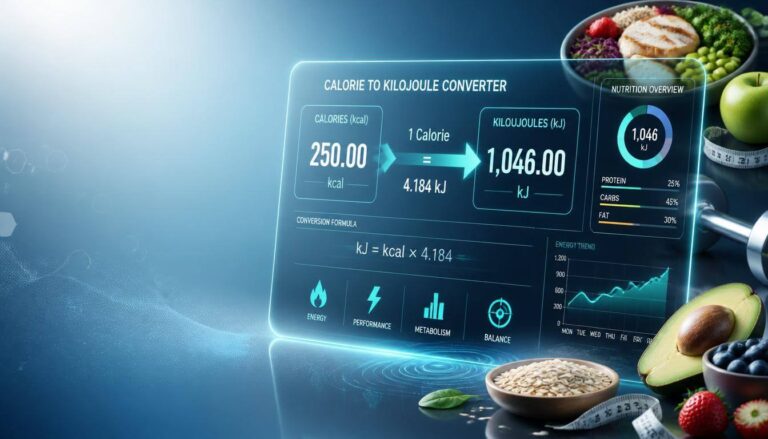
kJ = kcal × 4.184
Example:
250 kcal × 4.184 = 1046 kJ
This conversion is commonly used in:
- Food manufacturing
- Nutrition databases
- Diet planning software
- International product labeling
kJ to Calories in Weight Loss and Fitness
Many people track calories to maintain a calorie deficit or muscle-building diet. However, imported food products often display only kilojoules.
Learning kJ conversion helps users:
- Monitor daily intake accurately
- Compare packaged foods
- Understand restaurant nutrition data
- Calculate meal energy quickly
For example:
A daily target of 2,000 kcal equals approximately:
- 8,368 kJ
This number appears frequently in official dietary guidelines.
Scientific Background of Energy Conversion
The relationship between joules and calories comes from thermodynamics and heat energy studies.
Historically:
- Calories were used in chemistry to measure heat.
- Joules became the official SI energy unit later.
Today:
- Physics mainly uses joules.
- Nutrition still widely uses calories.
Because food energy is technically heat energy released during metabolism, both units remain relevant in nutrition science.
Online kJ to Calories Converters
Digital conversion tools simplify calculations and reduce human error.
A high-quality kJ to calorie converter should include:
- Instant calculation
- Mobile responsiveness
- Decimal precision
- Reverse conversion option
- Nutrition examples
- Conversion tables
- SEO-friendly educational content
Users also prefer calculators that explain formulas instead of only displaying numbers.
Best Practices for Accurate Conversion
To ensure reliable energy conversion:
- Use the exact factor 4.184
- Verify nutrition label units carefully
- Distinguish kcal from cal
- Round appropriately
- Use trusted nutrition databases
Accuracy matters in:
- Clinical nutrition
- Sports performance
- Medical meal planning
- Scientific research
- Food labeling compliance
Final Thoughts
Understanding how to convert kJ to calories is essential for interpreting nutrition labels, tracking dietary intake, and comparing energy values globally. Although the calculation is mathematically simple, accuracy matters because calorie tracking directly affects nutrition planning, fitness goals, and health management.
The standard formula remains:
Calories (kcal) = kJ ÷ 4.184
Once you understand the relationship between kilojoules, calories, and kilocalories, reading food labels and managing energy intake becomes significantly easier. Whether you are calculating meal energy, comparing packaged foods, or building a nutrition-focused website, mastering this conversion provides long-term practical value.
For quick daily energy conversions, bookmark the kJ to Cal Converter to instantly convert kilojoules into calories without manual calculations.
Frequently Asked Questions (FAQs)
About the Author

Nutrition & Energy Conversion Content Specialist (Australia)
Ethan Mitchell is a health and nutrition content specialist focused on simplifying energy conversions for everyday users in Australia. He creates clear and accurate content to help people understand and convert kilojoules to calories with ease. His work is based on trusted nutritional references and aligned with Australian food labeling standards, making complex energy information simple and practical for all users.