kJ to kcal Explained: What the Numbers on Food Labels Actually Mean
You pick up a snack, flip it over, and see two energy numbers sitting side by side – one in kJ, one in kcal. Most people ignore one of them. Some people aren’t sure which one actually matters. And almost nobody explains why both are there in the first place.
This article fixes that. By the end, you’ll know exactly what each unit means, how they connect, and how to read either one without needing a calculator.
What Is a Kilojoule (kJ)?
A kilojoule is a unit of energy from the International System of Units — the metric system used by scientists, engineers, and most of the world. The “kilo” prefix means one thousand, so one kilojoule equals 1,000 joules.
In the context of food, a kilojoule measures how much energy your body can extract from what you eat or drink. It’s not a measure of nutrition quality, protein, or fat — just raw energy.
Simple definition: 1 kJ = 1,000 joules of energy.
Countries like Australia, the UK, and most of Europe display kilojoules prominently on food packaging because their labelling standards follow metric conventions. That’s why kJ tends to appear first or most visibly on products from those regions.
What Is a Kilocalorie (kcal)?
A kilocalorie is also a unit of food energy, but it comes from a different measurement tradition. One kilocalorie is the amount of energy needed to raise the temperature of one kilogram of water by one degree Celsius.
Here’s the part that confuses almost everyone: the “calorie” printed on most food labels is actually a kilocalorie.
When a nutrition facts panel says a food contains “250 calories,” it technically means 250 kilocalories (kcal). The word “calorie” on packaging is shorthand — always has been. A true calorie (with a lowercase “c”) is 1,000 times smaller and essentially useless for measuring food energy.
Simple definition: 1 kcal = 1 food Calorie = the energy to raise 1 kg of water by 1°C.
The United States, Canada, and several other countries use kcal as the primary energy unit on their nutrition facts panels, regulated by bodies like the Food and Drug Administration (FDA). This is why American packaging shows “Calories” rather than kilojoules.
kJ vs kcal: The Core Difference
| kJ (Kilojoule) | kcal (Kilocalorie) | |
|---|---|---|
| System | Metric (SI) | Traditional / Imperial |
| Used in | Australia, UK, Europe | USA, Canada |
| Labels show | Energy in joules × 1,000 | Energy in “Calories” |
| Relative size | Smaller number | Larger number |
| Conversion | ÷ 4.184 → kcal | × 4.184 → kJ |
Both units measure the same thing — dietary energy — just expressed on different scales. Neither is more accurate than the other. They’re simply two different languages saying the same thing.
The Exact Conversion Formula
This is the relationship between them:
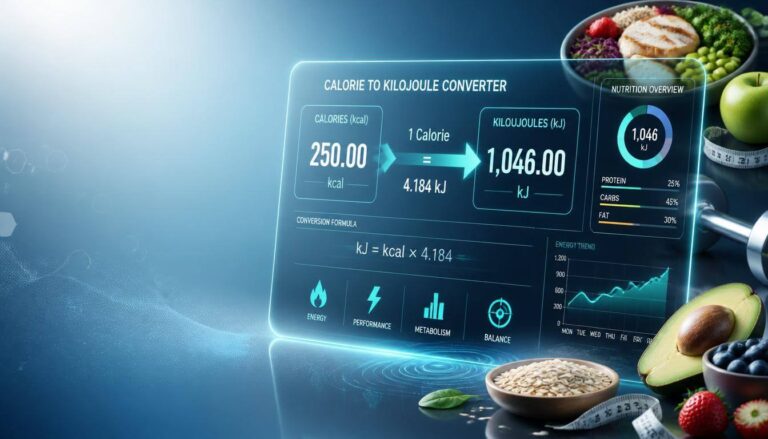
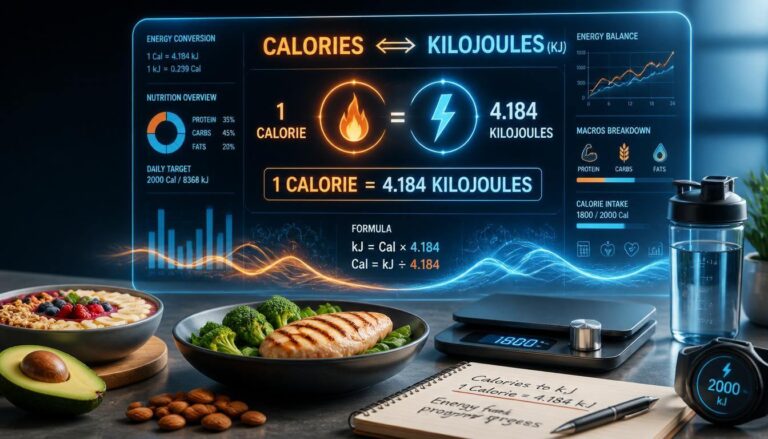
So to convert kJ to kcal, divide by 4.184. To go the other way — kcal to kJ — multiply by 4.184.
Formula: kJ ÷ 4.184 = kcal
Many nutrition labels and textbooks round this to 4.2 for simplicity, which introduces only a tiny margin of error that doesn’t matter in everyday use.
Quick Conversion Reference
| kJ | kcal (÷ 4.184) | Approx. kcal (÷ 4.2) |
|---|---|---|
| 100 kJ | 23.9 kcal | ~24 kcal |
| 500 kJ | 119.5 kcal | ~119 kcal |
| 1,000 kJ | 239 kcal | ~238 kcal |
| 2,000 kJ | 478 kcal | ~476 kcal |
| 8,700 kJ | 2,080 kcal | ~2,071 kcal |
The last row is significant — 8,700 kJ is the approximate average daily energy intake recommended in Australia, which corresponds to roughly 2,080 kcal. This mirrors the 2,000 kcal daily reference value commonly printed on American nutrition labels.
Reading a Real Food Label: A Practical Example
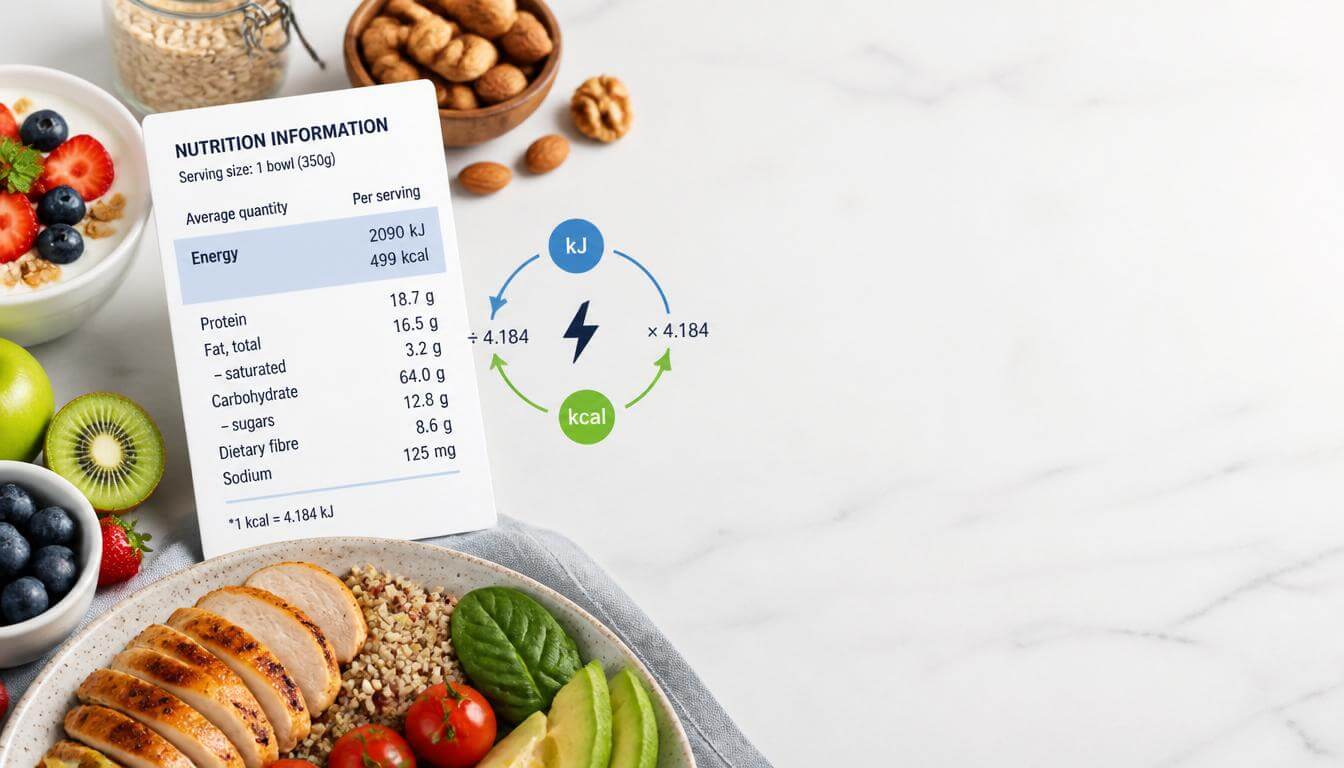
Say you’re looking at a yogurt with this label:
Energy: 627 kJ / 150 kcal per serving
Those two numbers describe identical energy content. The manufacturer has simply done the conversion for you and displayed both to serve customers in different markets or regions.
To verify: 627 ÷ 4.184 = 149.8 kcal — which rounds to 150. Exact.
Why Both Numbers Appear on Some Labels
Products sold across multiple markets — especially imported goods and international brands — often display both kJ and kcal to comply with different regional regulations. In the European Union, for example, food regulations require both units to appear on packaging. An Australian snack exported to Europe would need both. A UK product sold in a country where kcal is standard might carry both as a courtesy.
It’s a compliance choice, not a nutritional distinction.
The Common Confusion: “Calorie” vs “kilocalorie”
This is the single biggest point of misunderstanding around food energy.
Scientifically, there are two types of calories:
- calorie (cal) — a very small unit, used in chemistry labs
- Calorie (kcal) — 1,000 times larger, used in food and nutrition
On food packaging, the word “Calorie” (sometimes written with a capital C) always means kilocalorie. Always. No food label uses the small calorie because the numbers would be absurdly large — a single apple would show 52,000 calories instead of 52 kcal.
This convention is so deeply embedded in everyday language that “calorie” and “kilocalorie” are now used interchangeably in nutrition contexts. When someone says they eat 1,800 calories a day, they mean 1,800 kcal — or 7,531 kJ.
A Faster Mental Shortcut
If you don’t want to divide by 4.184 in your head, use this rough rule:
Divide kJ by 4 for a close kcal estimate.
It’s slightly off (the real divisor is 4.184), but for quick label-reading it’s accurate enough to give you a practical sense of energy content within about 4%.
Example: A chocolate bar with 1,260 kJ → 1,260 ÷ 4 = 315 kcal (actual: 301 kcal). Close enough for everyday use.
Why Different Countries Use Different Units
The short answer: history and regulation.
The joule became the globally preferred scientific unit of energy in 1948 when the International System of Units was formally adopted. Countries that modernised their labelling standards after this point — most of Europe, Australia, and New Zealand — adopted kilojoules.
The United States, however, had already built an entire nutritional framework around the kilocalorie and never switched. The FDA’s nutrition facts panel is built around kcal, and changing it would require overhauling decades of public health communication.
Both systems are equally valid. The unit used on your food label tells you more about where the product was manufactured than it does about the food itself.
What This Means When You’re Reading Labels
- If your label shows only kJ, divide by 4.184 to get kcal
- If your label shows only kcal, multiply by 4.184 to get kJ
- If it shows both, they’re the same value expressed differently
- The “Calories” on an American nutrition facts panel = kcal, not cal
There’s no need to prefer one unit over the other. Pick the one that feels familiar and convert when needed.
Summary: kJ to kcal in Plain Language
Kilojoules and kilocalories are two ways of measuring the same thing — the energy stored in food. They differ only in scale and regional convention. One kilocalorie equals 4.184 kilojoules, and that single relationship is all you need to move between them. Nutrition labels may show one, the other, or both depending on where the product is sold, but the energy content they describe is always identical.
FAQs: kJ to kcal Explained
About The Author

Nutrition & Energy Conversion Content Specialist (Australia)
Ethan Mitchell is a health and nutrition content specialist focused on simplifying energy conversions for everyday users in Australia. He creates clear and accurate content to help people understand and convert kilojoules to calories with ease. His work is based on trusted nutritional references and aligned with Australian food labelling standards, making complex energy information simple and practical for all users.