
Why Do Food Labels Use kJ?
Food labels in Australia, New Zealand, and the UK use kilojoules (kJ) because their governments mandated metric units as part of a national switch away from the imperial system — not because scientists decided kJ was better for consumers. It was a policy decision, made decades ago, that most people buying groceries today have never been told about.
Here is why it happened, what the law actually requires, and how to make the number on the label useful to you without ever doing the maths.
The regulatory history — when and why governments mandated kJ
In 1960, the International System of Units (SI) was formally adopted by international agreement at the General Conference on Weights and Measures. The joule became the globally recognised unit of energy across all scientific disciplines. Countries that committed to full metrication agreed to align their public measurements with SI units — and that included food energy.
Australia moved quickly. The Metric Conversion Act 1970 established the Metric Conversion Board and began a phased national rollout. By 1977, all packaged goods — including food — were required to be labelled in metric units. Food energy moved from Calories to kilojoules as part of that same sweep. New Zealand completed its own metrication in 1976 after establishing the Metric Advisory Board in 1969.
This was not nutritionists pushing for a better consumer tool. It was government standardisation policy — the same force that changed road signs from miles to kilometres. The kilojoule ended up on your breakfast cereal box for the same reason your petrol is sold in litres.
The joint Australia New Zealand Food Standards Code — specifically Standard 1.2.8, administered by Food Standards Australia New Zealand (FSANZ) — later codified this into law. That standard is what manufacturers are legally required to follow today.
Why the number looks so different (the psychology of large numbers on labels)
Pick up a muesli bar. It might say 1,130 kJ per serve. That number sounds enormous. In calories, the same serve is about 270 kcal — a number that feels far more manageable to most people.
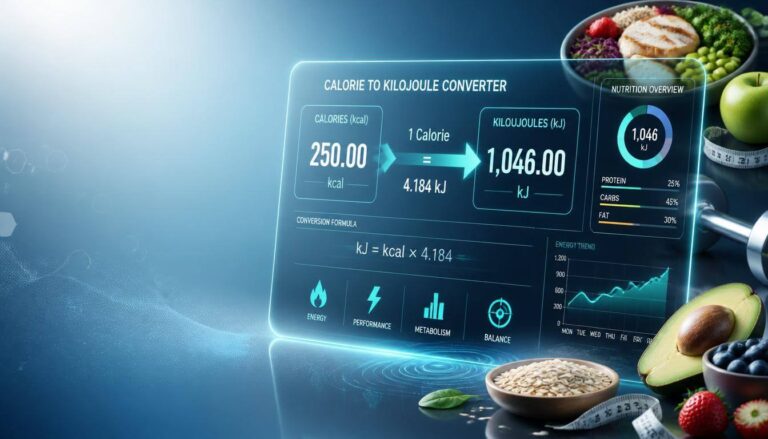
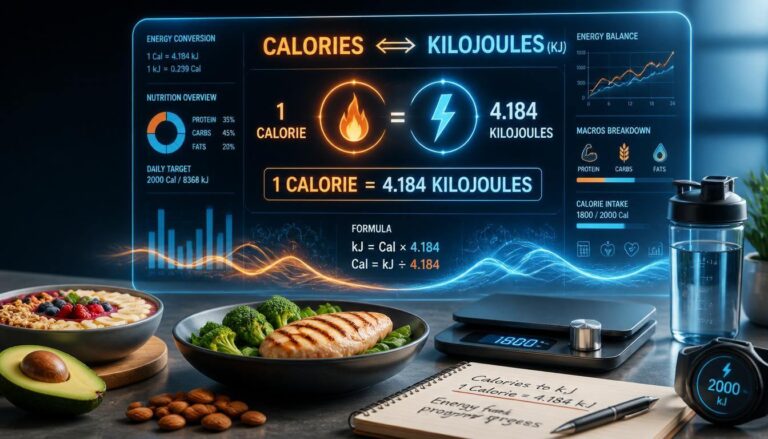
This is not a coincidence of physics. One kilocalorie equals exactly 4.184 kilojoules. The kJ figure is always roughly four times larger than the calorie equivalent. Every single time. So when you see a number on an Australian label and feel mild alarm, you are responding to a unit conversion, not to the actual energy content of the food.
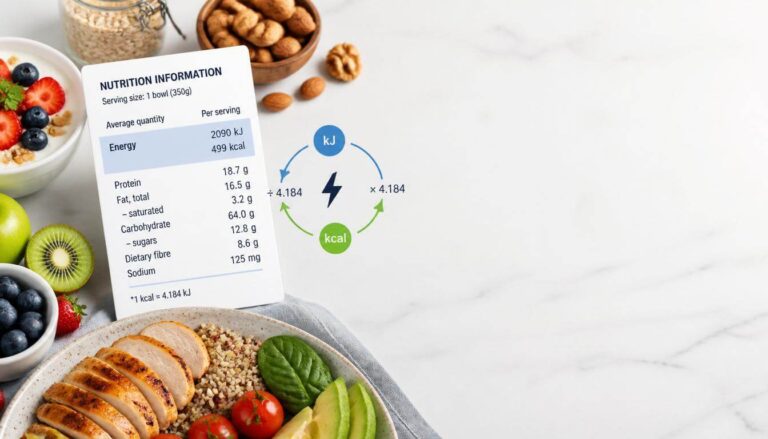
A real example: A 35g serving of Vita-Weat crackers shows 560 kJ / 134 kcal on the nutrition panel. The food is identical — the number is just four times larger depending on which unit you read first.
Research consistently shows that people anchor to the number they see, not to what it represents. A 560 kJ figure feels more alarming than 134 kcal, even though they are the same thing. This is not a flaw in your thinking — it is a known effect of numerical magnitude on perception. The switch to kJ did not make labels easier to understand. For most consumers, it made them harder.
Countries that use kJ vs calories — and the exact reason for the split
Uses kJ (primary)
kJ
Australia, New Zealand, China, South Africa, most of continental Europe
Uses kcal (primary)
kcal
United States, Canada (alongside kJ), India, Japan, South Korea
The split exists because of when each country committed to full metrication. The USA never completed that transition. The Metric Conversion Act of 1975 was passed, but it was voluntary — and the calorie had already been embedded in American nutrition culture since the 1880s, when chemist Wilbur Atwater introduced it to the public through publications like the USDA’s Farmers’ Bulletin. The calorie was the only widely recognised energy unit in English at the time, and it stuck.
The US Food and Drug Administration still requires calories (kcal) on its Nutrition Facts panel, and that standard has not changed. When you buy an American-made product imported into Australia, manufacturers typically add a local-compliant label showing kJ, or they show both units side by side.
The UK sits in an interesting middle position. It completed significant metrication, but food labelling was also shaped by European Union law. Under EU Regulation 1169/2011 — which the UK adopted before Brexit and retained thereafter — energy must be shown as both kJ and kcal on every label. So British consumers actually see both numbers every time they pick up a packet of crisps.
What food manufacturers are required to show by law
In Australia and New Zealand, Standard 1.2.8 of the Food Standards Code requires every nutrition information panel to list energy in kilojoules. Calories (kcal) are optional — manufacturers can include them, but the law does not require it. The mandatory reference for daily intake is 8,700 kJ, which you will often see printed below a nutrition panel as context.
In the UK, Regulation 1169/2011 (retained post-Brexit) requires both kJ and kcal to appear together on the label — kJ listed first. The EU reference intake shown on packaging is 8,400 kJ / 2,000 kcal. Enforcement sits with local authorities, with oversight from the Food Standards Agency (FSA) in England and Food Standards Scotland.
The practical effect: if you live in the UK, you are legally guaranteed to see both numbers. If you live in Australia or New Zealand, you may only see kJ — unless the manufacturer voluntarily adds the calorie equivalent, which many do on premium and imported products.
The consumer confusion problem — and what labels are doing about it
FSANZ has acknowledged through its own consumer research that most Australians cannot accurately interpret the kJ figure on a label without a reference point. The mandatory 8,700 kJ daily intake statement was added to labels specifically to help — but research found most shoppers either miss it or do not connect it to the per-serve figure in front of them.
The more recent response has been front-of-pack labelling. Australia’s Health Star Rating system does not display kJ at all — it encodes energy into the star rating so consumers can compare products without needing to do any unit arithmetic. The UK’s traffic light system similarly leads with portion-based percentages rather than raw kJ values.
These systems are a quiet admission that the kJ figure alone has not served most consumers well. The number is legally required; the tools to make it usable are being bolted on separately.
What would happen if labels switched back to calories tomorrow? Manufacturers would face immediate compliance costs, labels would need reprinting, and decades of public health messaging built around kJ benchmarks would need reframing. The 8,700 kJ figure is embedded in school curricula, hospital dietitian tools, and government dietary guidance. Switching is not just a print job — it is a regulatory and public health infrastructure change. No government is currently pursuing it.
A practical tip for reading kJ labels without converting
You do not need to convert kJ to calories to use food labels effectively. Instead, use the per-100g column and compare products against each other rather than against a memorised number.
The rule of thumb
For everyday packaged foods in Australia and New Zealand: anything under 500 kJ per 100g is relatively low in energy density. Between 500–1,500 kJ is moderate. Above 1,500 kJ per 100g is energy-dense. You are comparing, not calculating — and comparison does not require conversion.
The per-100g figure is the most useful number on the panel because it eliminates the distortion of manufacturer-set serving sizes, which are often unrealistically small. Two products with the same kJ-per-serve might have very different kJ-per-100g figures if their serving sizes differ. The per-100g column is the honest comparison.
Frequently asked questions
About The Author

Nutrition & Energy Conversion Content Specialist (Australia)
Ethan Mitchell is a health and nutrition content specialist focused on simplifying energy conversions for everyday users in Australia. He creates clear and accurate content to help people understand and convert kilojoules to calories with ease. His work is based on trusted nutritional references and aligned with Australian food labelling standards, making complex energy information simple and practical for all users.